
Beyond the Board: Master the Mind Game with These Essential Chess Strategies
Master the board by moving past basic tactics and embracing long-term chess strategy. This quick guide breaks down five essential concepts to help you outmaneuver any opponent
3 min read
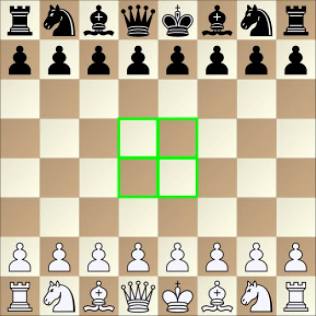
Controlling the center is the golden rule of the opening. When your pawns and minor pieces occupy or pressure these four central squares (shown in green above), you restrict your opponent's mobility and gain a launchpad for your own attacks. A knight placed on a central square attacks eight potential targets; banish that same knight to the edge of the board, and its influence is cut down to just two. Command the center, and you command the game.
2. The King's Fortress: Prioritize Castling and Safety
An exposed king is a magnet for disaster. Too many players delay castling, leaving their most valuable piece stranded in the middle of the board where open files can easily turn into corridors of doom.
Get your knights and bishops out of the way early so you can castle. This single, elegant move does two critical things at once: it tucks your king away behind a protective shield of pawns and swings your powerful rooks toward the center of the action. Once your king is safely nestled in its fortress, remember to keep its pawn shield intact—moving those pawns unnecessarily creates structural "holes" that enemy pieces will happily exploit.
To execute a castle, both your king and the chosen rook must be on their starting squares, with no pieces between them. You also cannot castle if your king is currently in check, or if the squares your king must cross or land on are under enemy attack.
When those conditions are met, you perform the move in two precise steps:
1.First move the king:
Slide your King exactly two squares toward the Rook you want to castle with (either kingside or queenside).
2.Then move the rook.
Pick up that Rook and hop it over the King, landing it on the square immediately adjacent to the King on the opposite side.
3. The Skeleton of the Game: Mind Your Pawn Structure
If the major pieces are the muscle of your army, the pawns are the skeleton. They move slowly and can never step backward, meaning every single pawn push is a permanent commitment.
A healthy pawn structure provides natural barriers for your king and solid outposts for your pieces. Conversely, fractured pawns—like isolated pawns (pawns with no friendly pawns on adjacent files(vertical columns of squares)) or doubled pawns (two pawns stacked on the same file)—quickly become easy targets for your opponent to gang up on. Before you push a pawn, ask yourself: "Is this opening a path for my pieces, or is it leaving a permanent weakness behind?"
4. Establish Outposts: Planting Long-Term Intruders
An outpost is a square on your opponent's half of the board that cannot be attacked by an enemy pawn.
If you can maneuver a piece—particularly a knight—into one of these deep-territory pockets, it becomes a permanent thorn in your opponent's side. Because short-range knights can jump over other pieces, an outpost knight acts like an aggressive forward scout, controlling critical escape squares and constantly threatening tactical forks. If your opponent can't easily steal your piece with a pawn, they will often have to waste valuable resources trying to trade it away.
5. Activity Over Material: The Trade-Off
Beginners are notoriously greedy, often valuing raw material over everything else. But a piece's theoretical value means nothing if it is trapped behind its own lines, doing absolutely nothing.
True chess strategy values piece activity above all. A highly active bishop slicing through open diagonals is far more valuable than a passive rook boxed in on an inactive corner. When looking to trade pieces, don't just calculate points; calculate energy. Look to trade off your "bad" inactive pieces for your opponent's highly active ones, leaving them cramped while your army enjoys total freedom of movement.
The Grandmaster Mindset
Chess isn't won by a single brilliant stroke; it is won by the accumulation of small, quiet advantages. By focusing on center control, king safety, solid pawn structures, and active pieces, you force your opponent into a defensive posture. The next time you sit down at the board, resist the urge to attack immediately. Take a deep breath, look at the structural landscape, and build a fortress before you build an army.
If you want to learn more advanced chess moves and gambits, visit this article:
Chess is often described as a battlefield, but in reality, it is a mentally stimulating conversation. Every move your opponent makes is a question, and every reply you draft is an answer. While beginners often get swept up in the immediate thrill of short-term tactics—chasing pieces like a dog chasing cars—the true masters of the game play with long-term strategy.
If you want to elevate your game from casual pusher to a calculating tactician, you need to think structurally. Here are the core strategic pillars that will transform how you see the board.
1. Dominate the Center: The High Ground of the Board
If chess were a physical war, the four central squares—d4, e4, d5, and e5—would be the absolute highest peak of the hill.